 Why Bali Is the World Capital of Yoga Teacher Training (And How to Choose Wisely)
Every year, thousands of aspiring yoga teachers fly to a small Indonesian island to change their lives. They come from North America, Europe, Australia, and beyond. They arrive in linen trousers with empty journals and leave four weeks later as certified yoga instructors. The island is Bali. And the question worth asking in 2026 is no longer whether Bali deserves its reputation — it clearly does — but why it earned that title, and how you can use that knowledge to make a genuinely smart decision about your training.
This guide answers both questions directly. It explains what makes Bali the dominant global destination for yoga teacher training, which parts of the island suit which types of students, how much everything actually costs, and what to look for — and look out for — when choosing a program. If you are seriously considering a yoga teacher training in Bali, this is the article you need before you book anything.
Why Bali? The Foundations of an Unlikely Capital
Bali did not become the world capital of yoga teacher training by accident. Several forces converged over roughly two decades to create the environment that exists today.
The most significant factor is cultural. Bali is a Hindu island within the world’s largest Muslim-majority country. The island’s spiritual framework is built around daily rituals, offerings to the gods, and a deep reverence for nature. This is not a backdrop — it is a lived reality. Balinese Hinduism follows the concept of Tri Hita Karana: living in harmony with one’s spiritual, social, and natural environments. <a href=”https://www.balispiritfestival.com/” target=”_blank” rel=”noopener noreferrer”>The BaliSpirit Festival</a> — one of the largest yoga and world music festivals on earth — is built explicitly around this principle. You cannot walk through a Balinese village without encountering woven palm-leaf offerings placed at doorsteps at dawn. You feel the spiritual undercurrent everywhere. For people pursuing a deeper relationship with yoga, this environment is genuinely nourishing.
The second factor is natural beauty. Bali’s landscape is extraordinary. Rice terraces cascade down volcanic hillsides. Sacred rivers cut through dense jungle. Ancient temples rise from clifftops above the Indian Ocean. Practising yoga in this environment is qualitatively different from practising in a studio in a city. The sensory dimension of training — the light, the sound, the air — becomes part of the experience itself.
The third factor is the international teacher network. Bali has become a hub for world-class yoga educators from India, the United States, Australia, and Europe. Many of the best teachers in the world now spend significant time on the island. This means that training in Bali gives you access to a quality and diversity of instruction that would be difficult to find in a single location anywhere else.
Finally, there is the cultural moment created by Eat Pray Love. Elizabeth Gilbert’s memoir — and the 2010 film adaptation — placed Ubud specifically on the spiritual seeker’s map. The word Ubud itself derives from the Balinese word Ubad, meaning medicine. The city’s reputation as a place of healing has deep roots, and Eat Pray Love amplified that reputation globally. The yoga scene in Ubud began expanding rapidly in the years that followed.
The Unique Training Environment Bali Provides
Understanding why Bali works as a training environment means understanding what makes yoga teacher training effective in the first place.
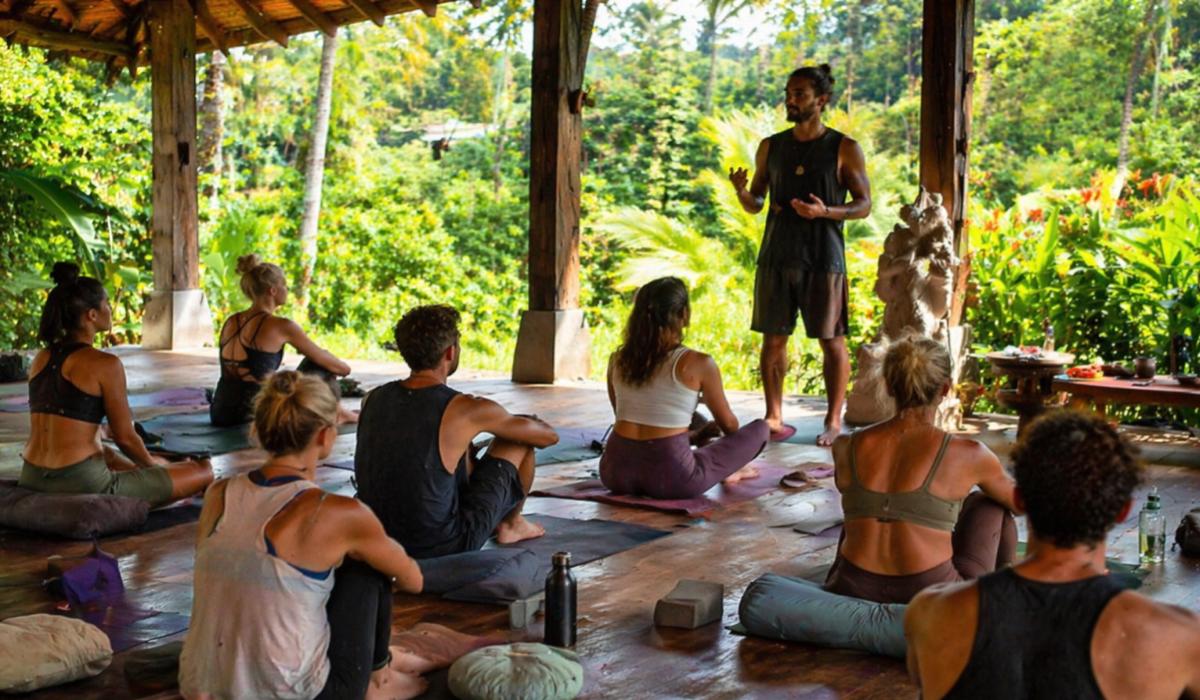
Teacher training is not a process that happens only in the classroom. It happens in everything surrounding the classroom as well. The food you eat, the walks you take, the conversations you have over dinner, the ceremonies you stumble into — all of it shapes your relationship to the practice and to teaching. In Bali, nearly everything in the surrounding environment reinforces the work you are doing on the mat.
<a href=”https://baliyogaguide.com/bali-yoga-teacher-training/” target=”_blank” rel=”noopener noreferrer”>The vivid scenery, lush nature, warm weather, and fresh, healthy food all contribute to making Bali an ideal destination for yoga.</a> Ubud’s raw vegan restaurants and Canggu’s plant-based cafés attract some of the best wellness-focused food in the world. You are not fighting your diet during training. You are supported by it.
The Balinese people add another dimension. They are widely recognised for their warmth and genuine hospitality. There is no feeling of being an outsider participating in someone else’s spiritual practice. The Balinese openly share their culture with visitors. You are invited into ceremonial life in a way that feels generous rather than performative.
There is also the community dimension. Bali draws what can fairly be called the largest concentration of yoga practitioners in the world at any given time. You will train alongside students from twenty or more different countries. The relationships formed during a Bali YTT (yoga teacher training) are often lasting. Many graduates continue to collaborate, travel, and teach together long after the program ends.
Where in Bali: Understanding the Key Training Locations
Bali is larger than most visitors expect. Choosing where to train matters as much as choosing which school to attend. Each region has a distinct character and attracts a different type of student.
Ubud: The Spiritual Heart
Ubud is the natural starting point for most yoga students. <a href=”https://jogayogatraining.com/yoga-teacher-training-in-bali-complete-guide/” target=”_blank” rel=”noopener noreferrer”>Ubud is Bali’s spiritual heart, surrounded by sacred temples and misty jungle</a> — rice paddies, eco-resorts, and sound healing ceremonies are woven into daily life here. The most famous yoga venue on the island is The Yoga Barn, which has been central to Ubud’s yoga identity for years and serves as the primary venue for the BaliSpirit Festival.
Ubud is the right choice if your priority is immersion, introspection, and cultural depth. You will spend time in one of the most visually striking environments on earth. The town’s dining scene is strong, with dozens of plant-based restaurants and organic cafés. There are world-class spas. Ancient temples are walking distance from most accommodation. This is the right environment for students who want quiet evenings and deep inward focus during their training.
The trade-off is that Ubud is inland. It is not a beach destination. Traffic in the town centre can be dense, especially during peak tourist seasons. Expect to pay slightly more for accommodation in Ubud’s best areas.
Canggu: The Modern Yoga Village
Canggu sits on Bali’s southwest coast and has evolved into what many describe as Bali’s modern yoga village. <a href=”https://jogayogatraining.com/yoga-teacher-training-in-bali-complete-guide/” target=”_blank” rel=”noopener noreferrer”>Canggu is Bali’s modern yoga village — surf culture, smoothie bowls, coworking cafés, and a vibrant yoga scene</a> coexist here. It is busy, social, and buzzing with energy. The beaches are real, the surf is excellent, and the international food scene is extensive.
Canggu suits students who want community and connection alongside their training. You will meet more people. You will have more options for evenings and weekends. The pace is faster. If you find deep solitude difficult to sustain for four weeks, Canggu gives you enough stimulation to stay energised without becoming distracted.
The training schools here tend to attract younger students and those for whom a beach lifestyle is important. The yoga teaching quality is not inferior to Ubud — many excellent Yoga Alliance–registered schools operate from Canggu. The environment is simply different.
Uluwatu and Nusa Lembongan: Quieter Alternatives
Uluwatu, on Bali’s southern tip, offers a less crowded alternative with dramatic ocean cliffs and world-class surf breaks. It suits students who want beach access without the bustle of Canggu. Several well-regarded YTT programs operate from here.
Nusa Lembongan is a small island a short ferry ride from Bali’s mainland. It operates at a slower pace than anywhere on the main island. <a href=”https://www.allyogatraining.com/yoga-teacher-training-bali.html” target=”_blank” rel=”noopener noreferrer”>All Yoga Training has run one of Bali’s longest-running teacher training programs from Nusa Lembongan since 2009</a>, drawing students who want an intimate, beachfront experience away from tourist crowds.
What a Bali Yoga Teacher Training Actually Costs
Cost is one of the strongest practical arguments for training in Bali. The numbers are significantly better than training in Western countries, and the quality is not compromised.
<a href=”https://jogayogatraining.com/yoga-teacher-training-bali-cost/” target=”_blank” rel=”noopener noreferrer”>In the West, a typical 200-hour yoga teacher training can cost between $3,000 and $5,000 USD, often excluding accommodation or meals.</a> In Bali, most all-inclusive 200-hour programs — covering tuition, accommodation, and meals — fall between $1,500 and $3,000 USD. <a href=”https://jogayogatraining.com/yoga-teacher-training-bali-cost-2/” target=”_blank” rel=”noopener noreferrer”>The average price for a 200-hour yoga teacher training in Bali is between $1,000 and $2,500, depending on the school and level of accommodation.</a>
A realistic all-inclusive budget for a quality, Yoga Alliance–registered 200-hour program with good accommodation runs approximately $2,000 to $2,700 USD. Top-tier luxury programs at high-end resorts can push higher. Budget programs at the lower end sometimes compromise on accommodation quality or instructor experience — a trade-off worth examining carefully before booking.
Beyond the program itself, budget for:
Flights. A return flight from the UK or Europe to Bali (Denpasar, DPS) typically costs around £400 to £700. From the US East Coast, expect $800 to $1,200 USD. From Australia, significantly less.
Visa. Indonesian visa-on-arrival for 30 days costs USD $35. If you plan to stay longer than 30 days, apply for the correct extension in advance.
Additional living costs. Bali is affordable. Meals outside your program, transport, temple visits, and occasional spa treatments will not strain a reasonable budget. Allow $15 to $30 USD per day for extras.
The total investment for a month-long Bali YTT — including flights, program fees, visa, and living expenses — is substantially less than completing the same training in London, New York, or Sydney. And unlike completing training at home, you arrive back having had a genuinely transformative life experience alongside your certification.
The Best Time of Year to Train in Bali
Timing your trip well makes a practical difference to your experience.
Bali has two distinct seasons. The dry season runs from approximately April to October. This is the most popular time to visit. Days are warm and sunny, outdoor practice is comfortable, and travel around the island is easy. If you prefer reliable weather and the most active social scene, the dry season is your window.
The wet season runs from November to March. Afternoon and evening rains are common, often heavy. Temperatures stay warm but humidity rises significantly. However, the wet season has real advantages. Programs are less full. Prices are sometimes lower. The island feels quieter and more intimate. For students seeking deep internal work — Yin yoga, Kundalini, restorative practice, or meditation-heavy programs — the quieter wet season energy suits the work.
One Bali-specific consideration is Nyepi, the Balinese Day of Silence. This Hindu new year falls in March or April and is observed as a complete day of stillness — no lights, no noise, no travel, and no activity visible to the outside world. Bali’s international airport closes for 24 hours. If your training dates overlap with Nyepi, plan accordingly.
How to Choose a Yoga Teacher Training Program in Bali: The Smart Checklist
With hundreds of programs available, the challenge is not finding a yoga teacher training in Bali. It is finding the right one. Here is what to check before you commit.
Check Yoga Alliance Registration
The global baseline credential for yoga teaching is the RYT-200 (Registered Yoga Teacher, 200 hours) from Yoga Alliance. Most studios internationally recognise this credential when hiring teachers. To qualify for the RYT-200, your training must be completed at a Registered Yoga School (RYS) — a school that has been vetted and approved by Yoga Alliance.
<a href=”https://yogaalliance.org/explore-training-options/” target=”_blank” rel=”noopener noreferrer”>You can verify any school’s registration status directly on the Yoga Alliance website.</a> Do this before you book. A school that claims Yoga Alliance registration but does not appear in their directory is either unregistered or misrepresenting its credentials.
Investigate the Lead Trainer
The quality of your training lives or dies on the quality of the person teaching it. <a href=”https://yogaalliance.org/explore-training-options/” target=”_blank” rel=”noopener noreferrer”>Under current Yoga Alliance standards, Lead Trainers for 200-hour programs must hold the E-RYT 500 credential</a> — meaning they have completed 500 hours of yoga teacher training and have 2,000 hours of teaching experience. This is a meaningful bar.
Look up your lead trainer’s background independently. Find their professional website or social media presence. Look at their history of teaching. If a school is evasive about naming its lead trainers, or if the trainers listed do not appear to have verifiable credentials, treat that as a serious warning sign.
Read Real Graduate Reviews
Graduate testimonials on a school’s own website are a marketing tool, not an evaluation tool. Seek independent reviews on platforms like Google, BookYogaRetreats, and The Honeycombers, which curate independently reviewed Bali YTT programs. Look for patterns. Do graduates consistently mention the same strengths? Do any concerns come up repeatedly? Recent reviews (within the last 12 months) are most useful.
Ask the school to connect you with past graduates directly. A confident school with happy alumni will do this readily.
Understand Exactly What Is Included
Some programs advertise a deceptively low headline price that excludes accommodation, meals, or required course materials. Others include everything. Read the inclusions carefully and compare programs on an all-in basis. A $2,500 USD program that includes accommodation, two meals daily, airport transfer, and all materials may be better value than a $1,800 program where those costs are extra.
Assess Class Size
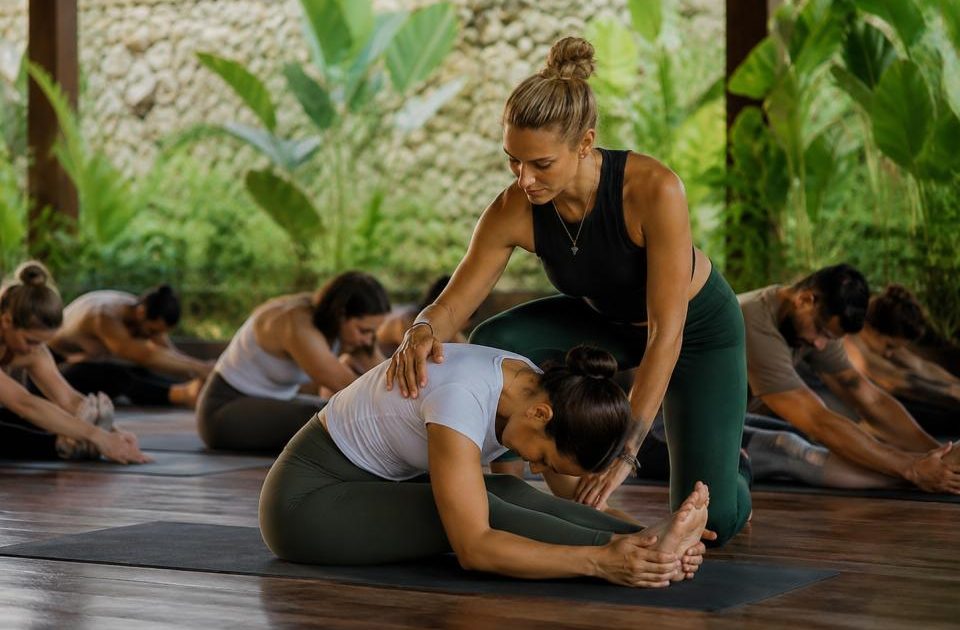
Smaller cohorts allow for more personalised feedback, deeper relationships with instructors, and more practice-teaching time per student. Look for programs that cap class sizes. Many reputable Bali programs limit to 15 to 22 students. <a href=”https://www.allyogatraining.com/yoga-teacher-training-bali.html” target=”_blank” rel=”noopener noreferrer”>Some established schools like All Yoga Training limit their training cohorts to a maximum of 22 students</a> specifically to protect the quality of individual attention each student receives.
Red Flags to Watch For
The growing popularity of Bali as a YTT destination has attracted some programs that prioritise profit over quality. These warning signs are worth knowing.
Extremely low pricing. A fully inclusive 200-hour program advertised under $800 to $1,000 USD almost certainly cuts corners somewhere — usually on instructor quality, class size, or curriculum depth. As one established school notes directly: cheap yoga teacher trainings are often a sign of a lower quality program.
Vague curriculum details. A legitimate school can give you a detailed breakdown of what each week of training covers. If a program’s website offers only general descriptions and avoids specifics, ask directly for the full syllabus.
No named lead trainer. If the school’s website does not name its lead training faculty, or names them without any verifiable credentials, be cautious.
Pressure tactics. Legitimate schools are confident in their programs. High-pressure sales tactics, artificially created urgency, and inflexible deposit policies without clear cancellation terms are worth questioning.
No physical address or verifiable location. Every Bali YTT should have a clear physical address you can look up on Google Maps and cross-reference against independent reviews.
What to Expect From a Typical Day in a Bali YTT
For students who have never done teacher training before, understanding the daily rhythm helps set realistic expectations.
Most programs run six days per week for three to four weeks. A typical day in a Bali YTT looks something like this:
Early morning (6:00–7:30am): The day begins with Shatkarma (cleansing practices), pranayama, and morning meditation, followed by a 90-minute led asana practice. Starting this early is deliberate — the morning energy in Bali is exceptional, and cooler temperatures make physical practice more comfortable.
Mid-morning (8:00–10:00am): Breakfast, followed by lecture-based learning. Topics rotate across anatomy, yoga philosophy, teaching methodology, and sequencing principles. You will study texts like Patanjali’s Yoga Sutras. You will learn about the chakra system, the history of yoga, and the ethical framework that underpins teaching.
Afternoon (12:00–5:30pm): After lunch and a Yoga Nidra (conscious relaxation) period, afternoons are typically dedicated to practicum — you practice teach, give and receive feedback, and work through alignment workshops. This is where classroom learning becomes applied skill.
Evening (after 6:00pm): Most programs leave evenings free. This is when you explore Bali. You eat at the local warung (small restaurant). You process the day. You write in your journal. You begin to understand what kind of teacher you want to become.
After the Training: What Comes Next
Completing a 200-hour YTT in Bali is the beginning, not the end.
Once home, most graduates register their credential with Yoga Alliance to receive the RYT-200 designation. Some also register with their national yoga alliance — such as the Canadian Yoga Alliance for Canadian teachers — to access group insurance rates and domestic employment opportunities.
Many Bali YTT graduates return to Bali for 300-hour advanced training, which combined with the 200-hour course qualifies them for the RYT-500 credential — one of the most respected designations in the industry. Others pursue specialty certifications in prenatal yoga, children’s yoga, or yoga therapy.
The international community you build during training in Bali often becomes a genuine professional network. Many graduates go on to teach retreats together, co-run online programs, or simply refer students to one another across different cities and countries. The Bali yoga community has a long reach.
Conclusion: Why Bali Is the World Capital of Yoga Teacher Training (And How to Choose Wisely)
Why Bali Is the World Capital of Yoga Teacher Training (And How to Choose Wisely) comes down to this: Bali offers a convergence of spiritual environment, world-class instruction, affordability, natural beauty, and international community that no other destination currently matches. The island’s Hindu culture, its role as a gathering point for exceptional yoga educators, and the everyday texture of life there make teacher training in Bali a qualitatively different experience from training at home or in most Western destinations.
The island is not a uniform destination, though. Ubud suits deep introspection and cultural immersion. Canggu suits community and coastal energy. Uluwatu and Nusa Lembongan offer quieter, more intimate alternatives. Each has genuine merit. The right choice depends on what you need from the experience.
Choosing wisely means verifying Yoga Alliance registration, researching lead trainer credentials, reading independent graduate reviews, understanding full program costs, and recognising red flags before you commit. The best Bali YTTs are genuinely excellent. The worst are expensive disappointments. The difference is due diligence.
If you are ready to become a yoga teacher — and you want the experience of training to be as transformative as the credential you earn — Bali in 2026 remains the world’s most compelling answer.