 A Day in the Life: What It’s Really Like During a Bali Yoga Teacher Training
The sound of a gong rings through the open-air shala. Mist still clings to the rice paddies outside. You sit cross-legged on a cotton mat, eyes closed, breathing in the scent of frangipani and damp earth. This is 6 a.m. in Ubud, and your day has only just begun.
Bali has become one of the world’s most popular destinations for yoga teacher training. Each year, thousands of students fly to this Indonesian island to deepen their practice and earn a certification. But what actually happens during those weeks? What does a typical day look like beyond the Instagram posts and glossy brochures?
In this guide, A Day in the Life: What It’s Really Like During a Bali Yoga Teacher Training, we walk through the rhythm of a real training day. We cover the early mornings, the long study sessions, the meals, the friendships, and the moments of doubt. By the end, you will know whether this experience aligns with your goals and what you can realistically expect when you arrive.
Why Bali Has Become the Global Hub for Yoga Teacher Training
Bali holds a special place in the modern yoga world. The island combines spiritual heritage, affordable living, and a community of seasoned teachers from around the world. Ubud, in particular, has earned a reputation as the spiritual and cultural heart of the island. You will find dozens of studios, healing centers, and certified schools within a short walk of the town center.
The appeal goes beyond aesthetics. Balinese Hindu culture weaves ritual and devotion into daily life. You see canang sari offerings on doorsteps each morning. You hear gamelan music drift through the streets. This environment supports the inward focus that yoga training requires.
Most reputable trainings in Bali are registered with Yoga Alliance, the international body that sets standards for teacher certification. A 200-hour program is the entry-level qualification, and many schools also offer 300-hour and 500-hour advanced courses. Costs are generally lower than equivalent programs in North America, Europe, or Australia, even when you factor in flights and accommodation.
The island also draws teachers from many lineages. You can study Vinyasa, Hatha, Yin, Ashtanga, or Kundalini under instructors who have trained in India, the United States, and across Europe. This diversity gives students a broader foundation than many home-country programs.
Waking Up Before Dawn: The 5:30 a.m. Start
Your alarm goes off at 5:15 a.m. The sky outside is still dark, and the first roosters are already crowing. You splash cold water on your face, pull on loose clothes, and walk to the shala along a path lined with moss-covered statues.
Most Bali yoga teacher trainings begin the day before sunrise. This is not arbitrary scheduling. In yogic tradition, the hours before dawn are called brahma muhurta, considered the most spiritually potent time of day. The air is cool, the mind is quiet, and distractions are minimal.
The morning usually opens with pranayama, the practice of breath control. You might spend twenty minutes on nadi shodhana, alternate nostril breathing, followed by kapalabhati or bhastrika. These techniques wake up the nervous system and prepare the body for movement.
Meditation follows the breathwork. Some schools guide you through a structured practice. Others leave you in silence. Either way, you sit. You watch your thoughts. You notice how your body feels after only a few hours of sleep.
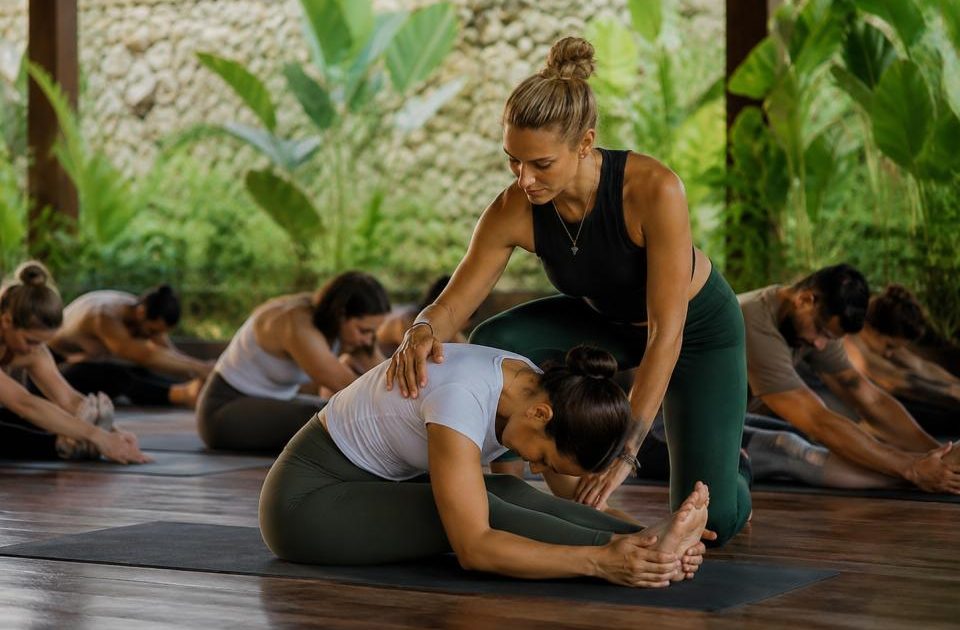
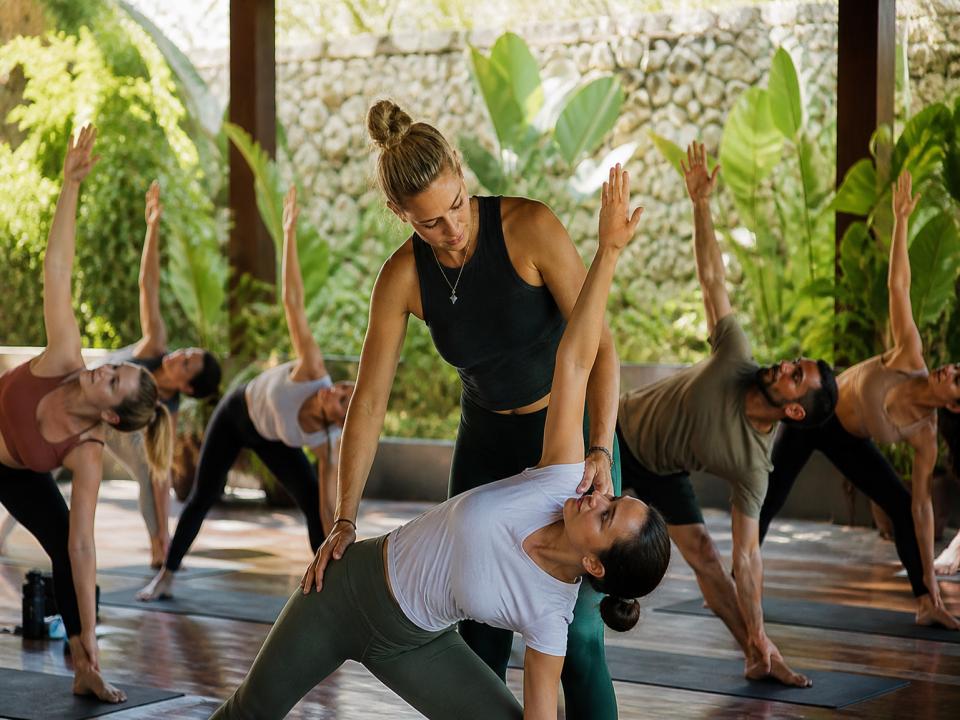
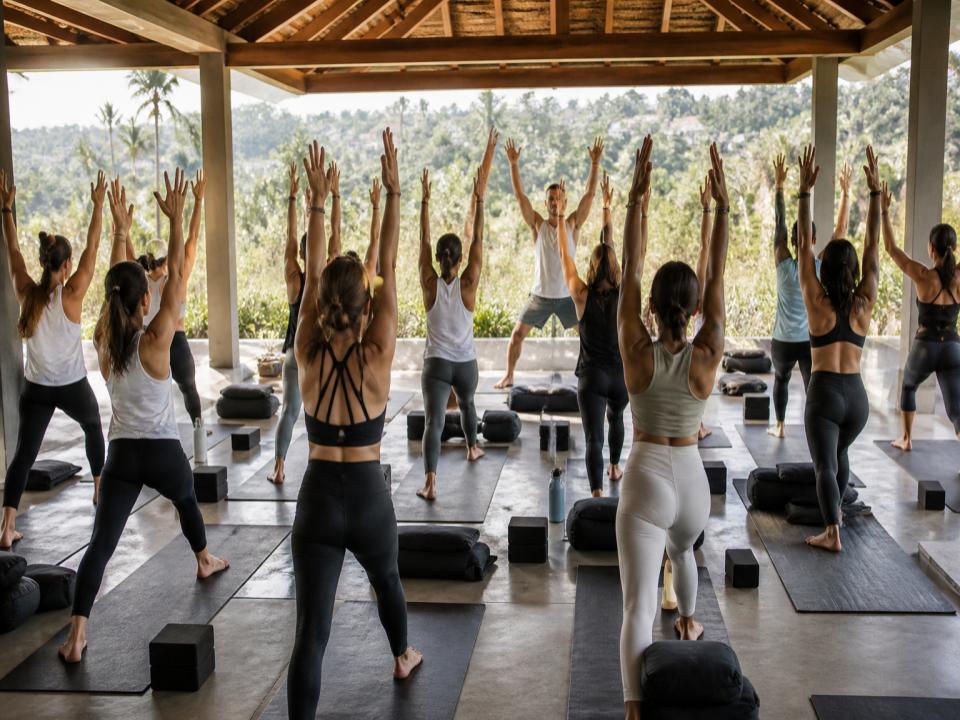
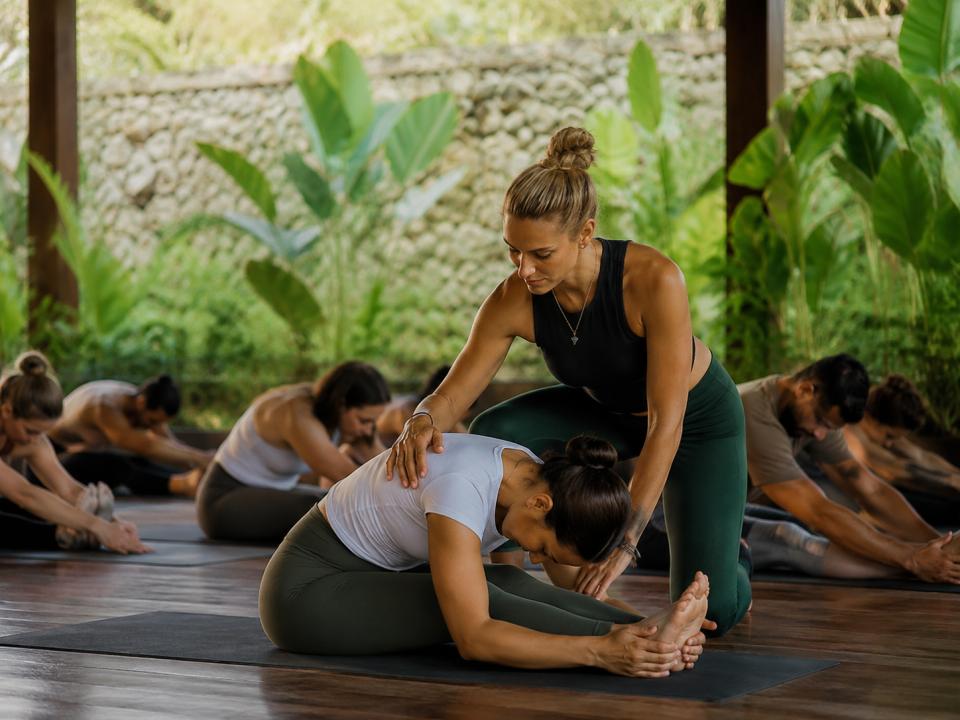
By 6:30 a.m., the physical asana practice begins. This is often the most demanding session of the day. You move through ninety minutes of postures, transitions, and held shapes. The teacher offers adjustments and corrections. Your muscles warm up. Your skin grows damp with sweat. By the time the session ends, the sun has climbed above the palm trees and the day feels entirely different than when you woke.
This early start is one of the biggest adjustments for new trainees. Most people find the first week exhausting. By the second week, your body adapts. By the third week, you may find yourself waking naturally before the alarm.
 The First Meal: Breakfast in a Tropical Setting
Around 8:30 a.m., the group gathers for breakfast. Most trainings include three meals per day, prepared by an on-site kitchen or a partner cafe nearby. Food is typically vegetarian or vegan, with options for gluten-free and other dietary needs.
Breakfast tends to be light and nourishing. You might find fresh tropical fruit, coconut yogurt, chia pudding, banana pancakes, or warm porridge with jackfruit and palm sugar. Many schools draw on the principles of Ayurveda, the traditional Indian system of health, when designing their menus. The goal is to support digestion without overloading the body.
This meal is more than fuel. It is the first chance to connect with your fellow trainees outside of class. Conversations move from quiet observations about the morning practice to deeper exchanges about why each person came to Bali. You learn that the woman next to you flew in from Buenos Aires. The man across the table is on a sabbatical from a corporate job in Berlin. The two friends at the end of the bench are recent graduates from Melbourne.
These shared meals become one of the most memorable parts of the experience. You eat slowly. You taste the dragonfruit, the salak, the mangosteen. You talk about your families, your fears, your goals as future teachers. Friendships form here that often last for years after the training ends.
Most schools observe a brief moment of gratitude before eating, sometimes in the form of a chant or a few seconds of silence. This small ritual helps you arrive at the meal with presence rather than distraction.
Morning Lectures: Philosophy, Anatomy, and the Why Behind the Practice
By 10 a.m., you are back in the shala for the first lecture session. This is the academic core of the training. Over the course of a 200-hour program, you will study several major subject areas, and the mornings are when most of this teaching happens.
Yoga philosophy is a central pillar. You read and discuss texts such as The Yoga Sutras of Patanjali, the Bhagavad Gita, and the Hatha Yoga Pradipika. You learn about the eight limbs of yoga, the yamas and niyamas, the koshas, the chakras, and the history of how yoga moved from ancient India to the modern world. Good teachers do not present this material as dogma. They invite you to think critically and apply the ideas to your own life.
Anatomy and physiology form another major block. You study the skeletal system, the muscular system, and how the body moves through common asanas. You learn the difference between hypermobility and stability. You discuss common injuries and how to teach around them safely. Some schools bring in guest instructors with backgrounds in physiotherapy or sports medicine to deepen this section.
You also study teaching methodology. How do you sequence a class? How do you cue a posture clearly? How do you adjust a student without causing harm? How do you hold space for someone going through emotional difficulty during practice? These skills are practical and require repetition to develop.
Lectures usually last two to three hours, broken up with short stretches and water breaks. You take notes. You ask questions. You realize that yoga is far larger and more complex than the studio classes you took back home.
Lunch and the Midday Rest
Around 1 p.m., the morning sessions end and the group breaks for lunch. The meal is usually the largest of the day. You might find nasi campur with tempeh and vegetables, Indonesian gado-gado, a hearty grain bowl, or a curry with brown rice and sambal on the side.
After lunch, most schools build in a rest period of two to three hours. This is not laziness. Your body and mind have been working since before dawn, and the afternoon sessions ahead are equally demanding. Without this pause, burnout sets in quickly.
How you use this break depends on your needs. Some trainees nap. Others swim in the pool if their accommodation has one. Many walk into Ubud town to visit a cafe, browse a bookshop, or pick up supplies. A short stroll through the Sacred Monkey Forest Sanctuary is a popular afternoon activity, though you learn quickly to keep your sunglasses and snacks tucked away.
This is also when you study. You review the morning’s lecture notes. You read the assigned chapters. You practice your sun salutation cues with a partner. You write in your journal about what came up during the morning meditation.
The midday break teaches you something subtle but important. Rest is part of the practice. In a culture that often celebrates constant productivity, learning to stop without guilt is a genuine skill. By the second week of training, most students stop fighting this pause and start to welcome it.
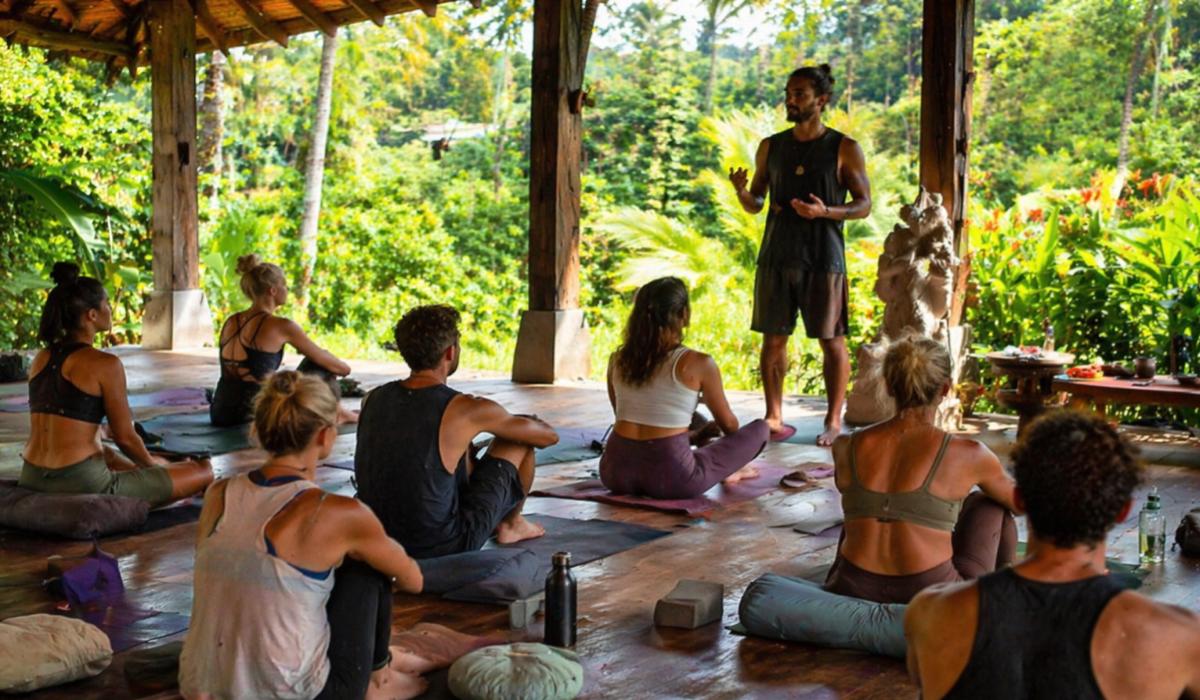 Afternoon Workshops: Where Theory Becomes Teaching
Around 3:30 or 4 p.m., the group reconvenes for the afternoon workshop. This is typically the most interactive part of the day. You move from being a student of yoga to being a future teacher of yoga.
These sessions vary widely in content. One afternoon you might focus on alignment principles for standing postures. The next day might cover inversions, with each student getting hands-on practice with handstands, headstands, or forearm balances using the wall and partner support. Another afternoon could be devoted to teaching meditation, or to designing a yin yoga sequence, or to understanding the use of props.
A significant portion of the afternoon is spent on practice teaching. You break into small groups. One person teaches while the others act as students. You receive feedback from your peers and from the lead trainer. You learn what your voice sounds like when you cue a downward dog. You discover that your pace is too fast, or that you forget to mention the breath, or that you stand frozen at the front of the room instead of walking through to offer adjustments.
Practice teaching is humbling. Almost every trainee finds it more difficult than expected. You realize that holding the room as a teacher requires presence, clarity, and a level of authority you may not yet feel. You also realize that the only way to develop this is through repetition. By the end of the training, most students teach a full hour-long class with confidence they did not have on day one.
Workshops also cover the business of yoga. How do you build a teaching schedule? How do you market yourself ethically? How do you set rates and handle bookings? Many schools bring in experienced studio owners to share practical advice. Resources such as Yoga Journal and The Yoga Teacher Resource are often recommended for ongoing learning after certification.
The Evening Practice and the Closing Circle
By 6 p.m., the sun is dropping toward the horizon. The light turns golden, then pink, then a deep blue. The shala is lit by candles and small lamps. The evening session begins.
This practice is usually slower and more restorative than the morning one. You might move through a gentle vinyasa, hold long yin postures, or settle into restorative shapes supported by bolsters and blankets. The aim is to release the tension built up over the day and prepare the body for rest.
Some evenings feature special practices. You might experience a yoga nidra session, the practice of conscious deep relaxation. You might join a kirtan, the call-and-response chanting of Sanskrit mantras. You might sit in a sound healing with crystal bowls or gongs. These experiences can be powerful, and many students describe them as emotional turning points in their training.
The day usually ends with a closing circle. The group sits together, often in silence at first. The lead teacher might offer a reading or a question to reflect on. Then each person speaks in turn. You share what came up for you that day. You name a moment of struggle, or a small win, or a realization that surprised you.
These circles build trust. You see each other clearly. You hear the doubts and breakthroughs of people who, only days earlier, were strangers. Many trainees describe the closing circle as the part of the day they remember most clearly years later.
Dinner follows, usually around 7:30 or 8 p.m. The meal is lighter than lunch. Soup, a simple curry, steamed vegetables, or a salad with tofu. By 9:30 p.m., most students are in bed. With another 5:15 a.m. alarm coming, sleep is not optional.
The Hidden Challenges Nobody Talks About
The marketing photos show smiling students in perfect headstands beside swimming pools. The reality is more nuanced. A Bali yoga teacher training is physically demanding, emotionally intense, and at times genuinely difficult. Understanding this in advance helps you prepare.
Physical fatigue is the most obvious challenge. You will practice for three to four hours each day, often in tropical heat and humidity. Your hamstrings will be sore. Your wrists will ache. Minor injuries flare up. Most schools build in one rest day per week, but even with that, the body needs time to adapt.
Emotional intensity is harder to predict. Long days of practice, study, and introspection bring up material you may not have looked at in years. Old griefs surface. Patterns become visible. Tears in the middle of a forward fold are common. Good trainings hold space for this with care, but they cannot remove the experience. Resources from the International Association of Yoga Therapists can offer further support for anyone working through this kind of personal material.
Group dynamics also play a role. You live and work with the same fifteen to thirty people for three or four weeks. Friendships form, but so do tensions. Personalities clash. Someone always talks too much in the closing circle. Someone else withdraws and worries the group. Navigating this is part of the training, and it builds skills you will need when you teach your own classes.
Then there is the practical reality of living in Bali. The heat is constant. The mosquitoes are persistent. Tap water is not safe to drink, and stomach issues affect most travelers at some point. Wi-Fi can be unreliable. The UK Foreign Office and similar government travel pages offer practical guidance on health, safety, and entry requirements for Indonesia. Reading these before you travel saves stress later.
Finally, there is the question of what you do with the experience when you go home. The bubble of the training is intense and supportive. Returning to ordinary life can feel jarring. Many graduates describe a period of adjustment that lasts weeks or even months.
 What You Take Home Beyond the Certificate
The Yoga Alliance certificate is the official outcome of the training, but most graduates will tell you it is not the most valuable part. The deeper changes are subtler and longer lasting.
You leave with a more honest relationship with your own body. After weeks of daily practice, you know your tight spots, your strong sides, and your habitual compensations. You learn the difference between effort and strain, between discipline and self-punishment.
You leave with a daily practice you can sustain. Many people come to Bali hoping to build a routine and leave with one that actually fits their life. Even a twenty-minute morning practice, repeated consistently, changes how you move through the world.
You leave with a community. The group chat from your training will stay active for years. People share teaching opportunities, ask for advice, send updates on their lives, and sometimes meet up again on the other side of the world.
You leave with the ability to teach, if you choose to. Some graduates begin teaching immediately. Others integrate the knowledge into other careers, applying it to therapy, coaching, healthcare, or education. Still others never teach formally but live differently because of what they learned. All of these outcomes are valid.
You also leave with a more grounded relationship to yoga as a whole. You understand it as a system, not just a workout. You know the names of the limbs. You can read a passage from the Yoga Sutras and discuss what it means. You see the studio classes back home in a new light, recognizing both their strengths and their limitations.
Practical Tips for Choosing the Right Bali Training
If this kind of experience appeals to you, the next step is choosing a program. Not all Bali trainings are equal. A careful selection process pays off enormously.
Start by verifying Yoga Alliance registration. The school should be listed as a Registered Yoga School, and the lead trainers should be Experienced Registered Yoga Teachers with the appropriate hours. You can search the public registry on the Yoga Alliance website to confirm credentials.
Look closely at the curriculum. A reputable 200-hour program covers asana, pranayama, meditation, philosophy, anatomy, teaching methodology, ethics, and practicum. If a course skips any of these, ask why. The breakdown of hours across categories should be transparent and available before you book.
Research the lead teachers. Read their biographies. Watch videos of them teaching. Look for years of experience, training in specific lineages, and a teaching style that resonates with you. A famous teacher is not always the right teacher for you. Compatibility matters more than reputation.
Read reviews carefully. Look beyond the school’s own website. Search for the program on Google, on Reddit, and on YouTube. Pay attention to detailed reviews that describe both the strengths and the weaknesses of the training. A program with only glowing testimonials may be filtering its feedback.
Consider logistics. Where exactly is the school located? Is accommodation included? What does the daily schedule look like? What is the maximum class size? What dietary options are offered? A small school with twelve students offers a very different experience from a large school with forty.
Finally, trust your instincts. If something feels off when you contact the school, take that seriously. The right training will feel welcoming, honest, and clear about what is included and what is not.
Conclusion
A Day in the Life: What It’s Really Like During a Bali Yoga Teacher Training is a question with many answers, but the underlying rhythm is consistent. You wake before dawn. You breathe. You move. You eat. You study. You rest. You teach. You sit in circle. You sleep, then begin again.
The main takeaway is this: a Bali yoga teacher training is not a retreat or a vacation. It is structured, demanding work that asks for your full presence over three or four intense weeks. The reward is a deeper understanding of yoga, a community of fellow practitioners, and tools that change how you live long after the certificate is issued.
If you are considering this path, take the decision seriously. Choose a reputable school. Prepare your body, your finances, and your expectations. Then arrive with an open mind. The island, the practice, and the people will do the rest.