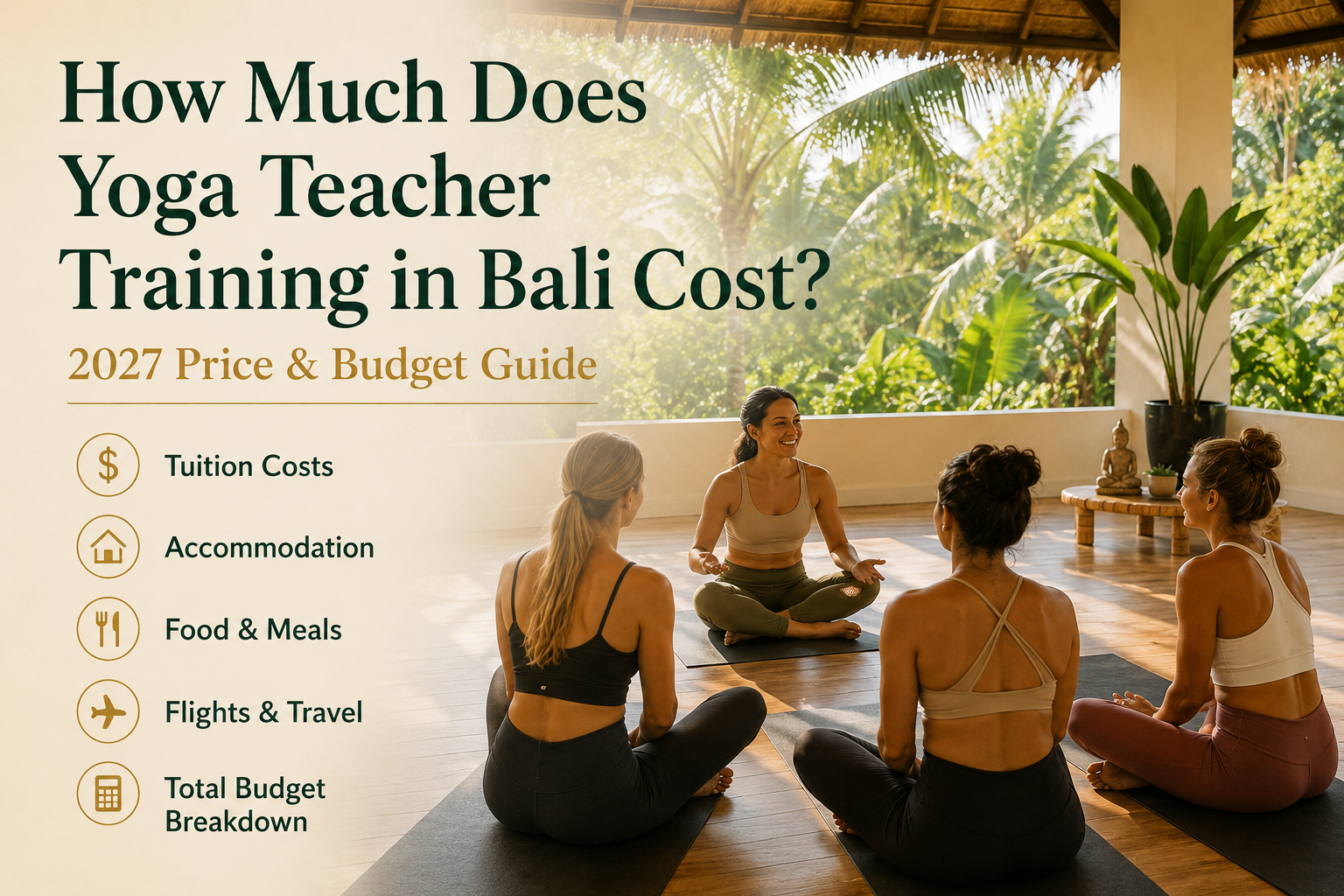
 How Much Does Yoga Teacher Training in Bali Cost? 2027 Price & Budget Guide
Bali is still the world’s top destination for yoga teacher training, and if you’re planning a trip in 2027, cost is probably your first question. This guide, How Much Does Yoga Teacher Training in Bali Cost? 2027 Price & Budget Guide, breaks down exactly what you’ll pay for tuition, visas, flights, and daily living, so you can build a realistic budget before you book anything.
Prices in Bali vary more than most first-time students expect. A 200-hour course can cost $1,300 or $3,500, and both prices might buy you a legitimate Yoga Alliance certification. The difference usually comes down to accommodation quality, class size, teacher experience, and what’s bundled into the fee. This guide walks through every cost category so you know what you’re actually paying for.
Average Cost of a 200-Hour Yoga Teacher Training in Bali
A 200-hour YTT is the entry-level certification most new teachers pursue, and it’s also the most common course offered in Bali. Based on current listings across the island, tuition typically falls between $1,300 and $3,500 for a residential program that includes accommodation, most meals, and course materials. Non-residential options, where you arrange your own housing, tend to sit at the lower end of that range.
Duration matters here too. Most 200-hour programs run 20 to 27 days, since Yoga Alliance requires a minimum number of contact hours spread across asana, anatomy, philosophy, and teaching methodology. A shorter course isn’t necessarily cheaper per day, and a longer one isn’t automatically better. According to YTTinBali’s 2026 program comparison, programs run nearly every month of the year and generally cost between $1,800 and $3,500 with accommodation and meals included.
Location within Bali also shifts the price. Schools in Canggu and Uluwatu, both popular surf and beach towns, tend to charge more for private rooms and ocean-view shalas. Schools on Nusa Lembongan, a smaller island off Bali’s east coast, often come in cheaper because land and labor costs are lower there. All Yoga Training’s Nusa Lembongan program, for example, lists a 23-day course with one rest day every six days, which keeps costs down without cutting the curriculum short.
If you see a 200-hour course priced well under $1,300, ask more questions before enrolling. Extremely low tuition often means larger class sizes, less experienced faculty, or facilities shared with other schools. That doesn’t automatically make a program bad, but it’s worth confirming Yoga Alliance registration and reading recent graduate reviews before you commit.
Average Cost of a 300-Hour and 500-Hour Yoga Teacher Training
Once you’ve completed your 200-hour certification, many teachers return to Bali for a 300-hour advanced training, which combines with the 200-hour to form a 500-hour credential. These courses go deeper into anatomy, sequencing, and specialized styles like Yin, aerial, or restorative yoga.
Pricing for 300-hour trainings generally runs from about $1,950 to $3,500, with an average closer to $2,500 according to BookRetreats’ 2026 market overview, which notes that program length typically spans 22 to 35 days. That’s a slightly wider range than the 200-hour tier, partly because 300-hour students often want more specialized instruction, and specialized faculty cost more to bring in.
Faculty specialization plays a bigger role in 300-hour pricing than it does at the 200-hour level. Because advanced trainings often bring in guest teachers for niche modules, like Yin, restorative, or aerial yoga, schools that offer a wider range of specialties tend to charge more. If you already know which style you want to teach, it’s worth checking the specific faculty lineup for each course date rather than assuming every 300-hour program covers the same ground.
Some schools offer discounts for returning students. Bali Yoga Ashram, for instance, has offered alumni pricing of a few hundred dollars off the 300-hour course for students who completed their 200-hour training with the same school. If you already have a school you trust, it’s always worth asking about loyalty pricing before you shop elsewhere.
A combined 500-hour program, booked as a single package rather than two separate trips, can sometimes save money compared to paying for both courses individually. However, this only makes sense if you’re confident about committing six to eight weeks in Bali at once, since most combined programs run back-to-back with little to no break between the two certification levels. If you’re not sure you want to teach full-time yet, it’s often smarter to complete your 200-hour first, gain some teaching experience, and decide later whether the 300-hour investment makes sense for your career goals.
 What’s Usually Included in the Tuition Price
Understanding what’s bundled into your tuition is the single biggest factor in comparing prices accurately between schools. A $1,800 course that includes nothing but classes is not necessarily cheaper than a $2,800 course that includes a private room, three meals a day, and a Yoga Alliance registration fee.
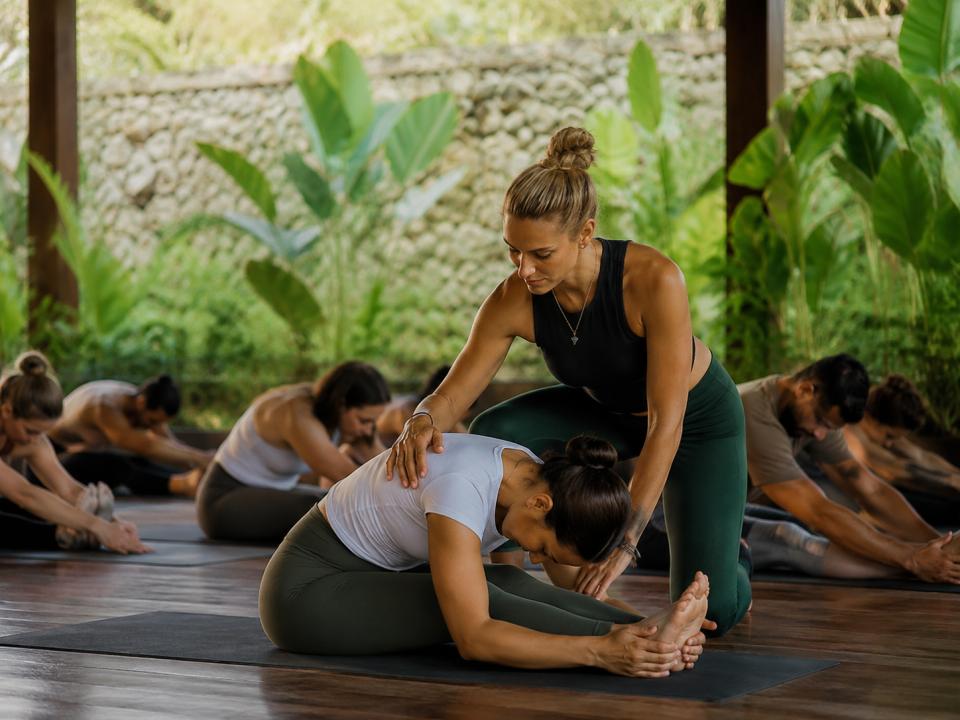
Most residential programs include shared accommodation, though private rooms are usually available for an added cost. Meals are typically included once or twice daily, often vegetarian or vegan, reflecting the wellness focus of most Bali yoga schools. Course materials, including manuals and sometimes textbooks on anatomy or philosophy, are usually part of the package. Airport transfers are commonly included as well, since many training locations sit outside Bali’s main airport hub in Denpasar.
What’s frequently excluded, and easy to overlook, includes your Yoga Alliance registration fee after graduation, which runs separately through Yoga Alliance’s own registration system, travel insurance, laundry service, and any excursions beyond what’s explicitly listed. Some higher-end schools bundle in extras like a Balinese massage, a water temple excursion, or daily juice and coffee service, which is worth factoring in if you’re comparing two similarly priced courses.
Before booking, ask the school for an itemized breakdown of exactly what’s covered. A reputable school will have no problem sending this in writing. If a program’s marketing page is vague about inclusions, that’s often a signal to dig deeper or look elsewhere.
Hidden and Additional Costs to Budget For
Tuition is only part of your total Bali YTT budget. International flights are usually the largest additional expense, and prices vary enormously depending on your departure city and how far in advance you book. Travelers from North America or Europe typically pay more than travelers from Australia or elsewhere in Asia, simply due to distance.
Travel insurance is non-negotiable for a trip this long, and most Bali visa categories require proof of coverage anyway. Basic policies covering a month-long stay are relatively affordable, but make sure your policy covers yoga-related activity, since some budget insurers exclude physical training programs or classify intensive yoga as an adventure activity requiring an upgraded plan.
Personal spending is easy to underestimate. Even with meals included, most students spend money on coffee, snacks, laundry, spa treatments, and day trips on rest days. Bali’s cost of living is low by Western standards, but it adds up over three or four weeks. Budgeting an extra $10 to $25 per day for incidentals is a reasonable starting point for most students.
Finally, don’t forget the Yoga Alliance registration fee once you’ve graduated. This is separate from your course tuition and is paid directly to Yoga Alliance to officially register as an RYT-200 or RYT-300 teacher. It’s a modest annual fee, but it’s easy to forget when you’re focused on the bigger training cost.
Bali Visa Costs for Yoga Teacher Training Students
Visa requirements changed in 2026, and it’s worth understanding the current system before you plan your trip. Most short-term visitors use the Visa on Arrival, which costs IDR 500,000, roughly $32 to $35 USD, and grants a 30-day stay according to Eka Putra Tour’s 2026 visa guide. This can be extended once for another 30 days, which covers most standard 200-hour programs comfortably.
If your training runs longer, or you plan to travel around Indonesia afterward, you’ll likely need what was formerly called the B211A visa, now officially reclassified as the C1 Tourist Visa. This visa allows an initial 60-day stay and can be extended in 60-day increments up to a maximum of 180 days. According to Rumavi’s visa breakdown, a full 180-day stay using this visa category realistically costs between $380 and $550 all-in once government fees, agent fees, and extensions are factored in, not the roughly $150 that some agencies advertise for the initial application alone.
Working with a licensed visa agent is strongly recommended over navigating the process independently, especially since Indonesia updated its visa codes and fee structure in 2026. Agent fees add a modest premium to the government cost but save significant time and reduce the risk of paperwork errors that could delay your training start date. Also budget for Bali’s mandatory tourist levy of IDR 150,000, paid on arrival, which funds environmental and cultural preservation projects on the island.
Cost by Region: Ubud vs Canggu vs Uluwatu vs Nusa Lembongan
Where your training happens affects both tuition and daily living costs. Ubud, Bali’s cultural and spiritual center, hosts the highest concentration of yoga schools and tends to sit in the middle of the price range. It’s inland, surrounded by rice terraces, and generally quieter than the coastal towns, which some students prefer for focused training.
Canggu, a beach town popular with digital nomads and surfers, has become a major YTT hub in the past few years. Schools here often charge a premium for beachfront or near-beach shalas, and daily living costs, especially food and cafes, run higher than in Ubud due to Canggu’s booming expat scene.
Uluwatu, on Bali’s southern peninsula, is known for dramatic clifftop scenery and some of the island’s best surf breaks. Training programs here, like those offered through Ulu Yoga’s Uluwatu campus, often bundle in resort-style accommodation with ocean views, which pushes tuition toward the higher end of the range but can represent good value if a resort setting matters to you.
Nusa Lembongan, a small island a 30-minute speedboat ride from mainland Bali, tends to offer the most budget-friendly options. Land costs less there, the pace of life is slower, and there are fewer distractions, which some students see as an advantage for staying focused during an intensive training. The trade-off is limited nightlife and fewer amenities compared to mainland hubs, along with the added logistics and cost of the boat transfer.
 Budget vs Mid-Range vs Luxury YTT: What You Get at Each Price Point
Budget programs, generally under $2,000, typically offer shared dormitory-style accommodation, larger class sizes, and a straightforward curriculum without many extras. This tier works well for students who are primarily focused on the certification itself and don’t need resort-level comfort. Quality varies more at this price point, so graduate reviews matter more than they do elsewhere.
Mid-range programs, roughly $2,000 to $3,000, are the most common tier in Bali right now. At this price, expect smaller class sizes, often capped between 15 and 24 students, private room upgrade options, more experienced lead teachers, and additional inclusions like daily massage, excursions, or specialty workshops in styles like Yin or aerial yoga.
Luxury programs, above $3,000, usually include private villa or resort accommodation, very small class sizes, highly credentialed faculty with E-RYT status, and a genuinely retreat-like daily schedule with spa access, curated meal plans, and premium excursions. These programs suit students who want the training to double as a wellness retreat, not just a certification course.
None of these tiers is objectively “better” for becoming a competent, employable yoga teacher. Yoga Alliance certification requirements are the same regardless of what you pay, and a $1,800 course with a genuinely excellent, experienced teacher will prepare you better than a $3,500 course with a rotating cast of guest instructors. Price correlates more with comfort and amenities than with teaching quality, so weigh both factors independently when comparing schools.
How to Save Money on Your Bali YTT Without Sacrificing Quality
Booking during shoulder season, roughly April to June or September to November, often unlocks lower prices than peak months like July, August, and December, when demand and flight costs both spike. Schools sometimes run early-bird discounts of 15% to 25% for students who book several months in advance, so it pays to start researching well before your intended travel dates.
Sharing accommodation instead of booking a private room is the single biggest lever for cutting tuition cost, often saving $500 to $1,000 depending on the school. If you’re comfortable with a roommate for three to four weeks, this is usually the easiest place to trim your budget without affecting the actual training quality.
Choosing a location like Nusa Lembongan or inland Ubud over beachfront Canggu or Uluwatu can lower both tuition and daily spending money, since food, transport, and incidentals cost less away from the busiest tourist zones. Some students also extend their stay slightly before or after the course to enjoy Bali at a slower pace, which is usually cheaper per day than the intensive training period itself.
Finally, ask schools directly about payment plans, referral discounts, or alumni pricing on future courses. Many schools would rather offer a modest discount than lose a booking, particularly during slower months, so it’s always worth asking rather than assuming the listed price is final.
Total Budget Estimate: Sample 2027 Cost Breakdown
Putting these categories together, here’s a realistic total budget for a standard 200-hour, 23-day residential training in 2027, assuming a mid-range program with shared accommodation. Tuition typically runs $2,000 to $2,800. Round-trip international flights vary widely by departure city but commonly fall between $600 and $1,400. Visa costs, including a 60-day extension if needed, run roughly $50 to $150. Travel insurance for a month-long stay typically costs $40 to $90. Personal spending money for incidentals, at $15 per day over 23 days, adds approximately $345.
That brings a realistic total budget to somewhere between $3,000 and $4,800 for the full experience, tuition, travel, visa, insurance, and spending money combined. Students choosing a private room, a longer stay, or a luxury-tier school should expect this range to climb toward $5,500 to $7,000. Students on a tighter budget, using shared rooms, off-peak booking, and Nusa Lembongan or Ubud-based schools, can realistically bring the total closer to $2,500 to $3,200.
These figures will shift somewhat as exchange rates and flight costs change throughout 2027, so treat them as a planning framework rather than a fixed quote. Always confirm current pricing directly with your chosen school before booking, since tuition listed on comparison sites can lag behind a school’s live pricing page.
 Is Bali Yoga Teacher Training the Right Investment?
For many students, the value goes beyond the certification itself. A month immersed in daily practice, philosophy study, and a supportive community produces a level of personal growth that’s hard to replicate in a part-time local course spread across several months. The RYT-200 or RYT-300 credential you walk away with is internationally recognized, which matters if you plan to teach abroad or build an online teaching business.
That said, Bali YTT isn’t the only path to certification, and it isn’t automatically the right choice for everyone. Students with limited vacation time, tighter budgets, or family obligations that make a three-to-four-week trip difficult might be better served by a local or online program, even if the overall experience is different. It’s worth being honest with yourself about which factors matter most: the credential, the immersive experience, or simply the most efficient path to teaching.
If Bali is financially and logistically workable for you, the combination of low cost of living, high-quality instruction, and a genuinely transformative environment makes it one of the strongest values in the global YTT market. Just make sure you’re budgeting for the full cost, not just tuition, so there are no surprises once you land.
Frequently Asked Questions About Bali YTT Costs
Is a cheaper yoga teacher training worth the risk? Not always a risk, but it does require more research. A lower price often means fewer amenities rather than lower teaching quality, so check Yoga Alliance registration status and read graduate reviews on independent platforms before assuming a budget course is lower quality.
Do I need to pay for my Yoga Alliance certification separately? Usually, yes. Most schools include the cost of teaching you and preparing your application, but the registration fee paid directly to Yoga Alliance to activate your RYT-200 or RYT-300 status is typically a separate, smaller annual charge.
Can I negotiate the price with a Bali yoga school? Sometimes. Many schools offer early-bird pricing, shared-room discounts, or alumni rates, and some will work with you on a payment plan if you ask directly, particularly outside of peak season.
How far in advance should I book to get the best price? Three to six months ahead is a reasonable target. This gives you access to early-bird discounts, more date options, and enough time to arrange flights and visas without paying rush fees.
Are meals really included, and are they enough? Most residential programs include one to three meals daily, typically vegetarian or vegan, and portions are generally sufficient given the physical demands of the training schedule. If you have specific dietary needs, confirm with the school in advance rather than assuming they can accommodate you.
Conclusion
So, how much does yoga teacher training in Bali cost? This 2027 price and budget guide shows that a 200-hour certification typically runs $1,300 to $3,500 in tuition, while a full trip, including flights, visa, insurance, and spending money, realistically lands between $2,500 and $7,000 depending on your choices around location, accommodation, and program tier. The main takeaway is simple: price in Bali correlates with comfort and amenities far more than with teaching quality, so a smaller budget doesn’t mean a lesser education. Compare inclusions carefully, read recent graduate reviews, confirm Yoga Alliance registration, and budget for the full trip rather than tuition alone, and you’ll be in a strong position to choose a program that fits both your goals and your wallet.